Can You Weigh a Suitcase Without a Luggage Scale?
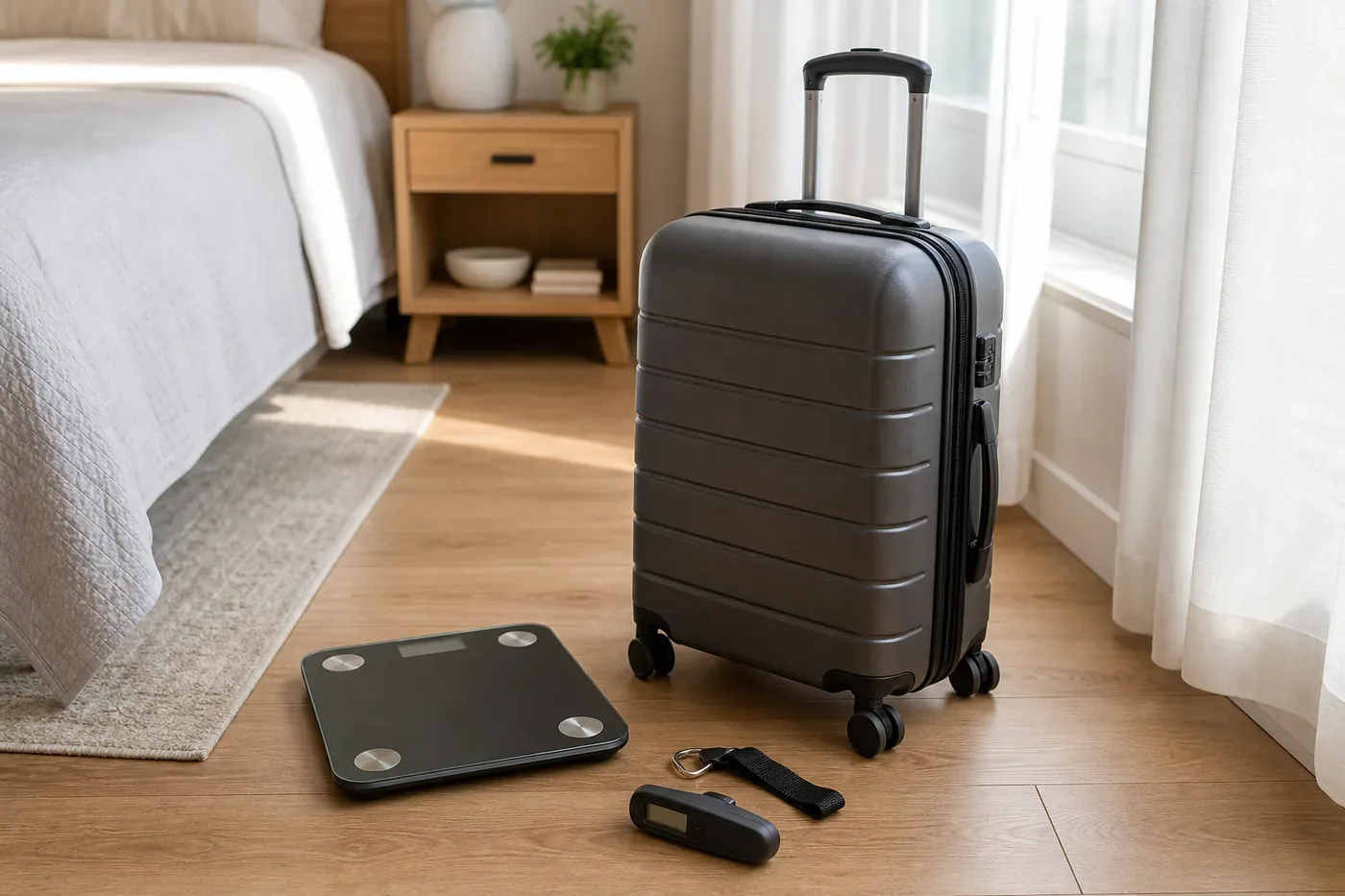
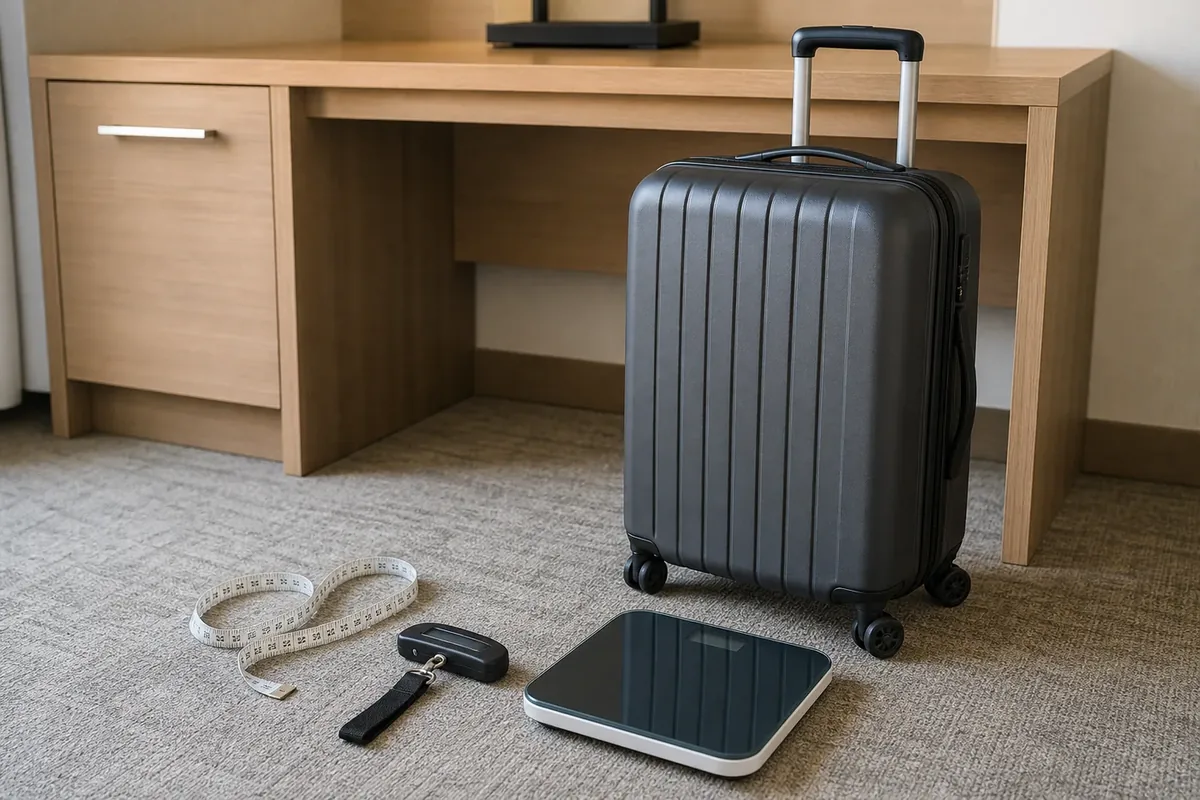
You can estimate a suitcase with an ordinary bathroom scale before leaving home. The calculation is simple: weigh yourself, weigh yourself again while holding the suitcase, and subtract the first reading from the second.
The harder part is deciding how much margin to leave. Bathroom scales, uneven floors, awkward lifting, and airline scales can disagree. A reading that lands exactly on the airline limit is not a comfortable result.
First check the rule you are trying to meet
There is no single worldwide suitcase limit. The U.S. Department of Transportation tells travelers to check the airline for baggage fees, overweight restrictions, and carry-on rules. Its baggage guidance also notes that carry-on standards can differ and that smaller aircraft may impose different restrictions.
Use the allowance shown for the operating carrier and fare on your exact itinerary, not a number remembered from a previous trip. Codeshare flights and connecting segments can make the operating airline especially important. Check both weight and dimensions; a light suitcase can still be oversized.
Confirm the rule again shortly before departure. The DOT’s ticket-buying guidance explains that airlines disclose baggage fees and restrictions, but the relevant details still come from the airline and ticket you purchased.
Use the bathroom-scale subtraction method
- Place the scale on a hard, level floor. Carpet can make some scales read inconsistently.
- Wear the same clothes for both readings and empty your pockets.
- Step on the scale without the suitcase. Wait for a stable reading and write it down.
- Step off, let the scale reset, and lift the closed suitcase securely.
- Step on while holding the suitcase close enough to remain balanced. Do not cover the display if you need to read it.
- Subtract your first weight from the combined weight.
- Repeat the full process two more times and compare the results.
For example, if you weigh 154.2 lb alone and 196.8 lb while holding the case, the estimated suitcase weight is 42.6 lb. In metric units, 89.3 kg minus 70.0 kg gives 19.3 kg.
If the three estimates vary widely, do not average them and pretend the result is precise. Reposition the scale, check the floor, replace a weak battery, or use another scale. If lifting the case threatens your balance, stop and ask for help or use a different method.
Can you put the suitcase directly on the bathroom scale?
Sometimes, but only if the suitcase fits without touching the floor and the display remains visible. Many cases overhang the platform, rest on wheels, or press unevenly. That can create an unstable reading and may scratch or damage the scale.
One workaround is to place a rigid board of known weight on a scale that supports the total load, zero the scale if its instructions allow, and place the suitcase on the board. This is not suitable for every scale, and a bathroom scale is not a shipping scale. Follow the manufacturer’s load and surface instructions.
How much margin should you leave?
Do not pack to the last displayed decimal. Home and airport scales can differ, and you may add food, gifts, paperwork, or damp clothing before the return flight. The appropriate margin depends on the airline limit and how much the home readings vary.
A practical approach is to remove something when your highest repeated reading is uncomfortably close to the limit. Put dense items such as shoes, books, liquids, and chargers on the packing list first. Moving an item to carry-on baggage helps only when the airline permits it and the item is allowed through security.
Never move spare lithium batteries into checked baggage merely to change the number. Follow the airline and aviation-safety rules for batteries, power banks, liquids, tools, and restricted items.
When a handheld luggage scale actually helps
A small hanging scale is useful when you cannot see a bathroom-scale display while holding the case, when you need a reading in a hotel without a scale, or when shopping and souvenirs change the return-trip load. It weighs the case directly through a strap rather than by subtraction.
It still requires a safe lift. Attach the strap to a strong suitcase handle, stand over the case, lift smoothly only high enough to clear the floor, and wait for the reading to stabilize. Do not twist, jerk, or hold a heavy case away from your body. A person with back, shoulder, grip, or balance concerns should not use a handheld scale without assistance.
Before buying, verify capacity, measurement units, battery type, display readability, strap and buckle design, auto-hold behavior, and whether the device can be calibrated. A claimed 50 kg capacity does not prove accuracy across the range.
A current digital luggage-scale example
Affiliate disclosure: This section contains an affiliate link. If you buy through it, GadgetPickLab may earn a commission at no extra cost to you. The listing below is a marketplace example, not a hands-on-tested endorsement.
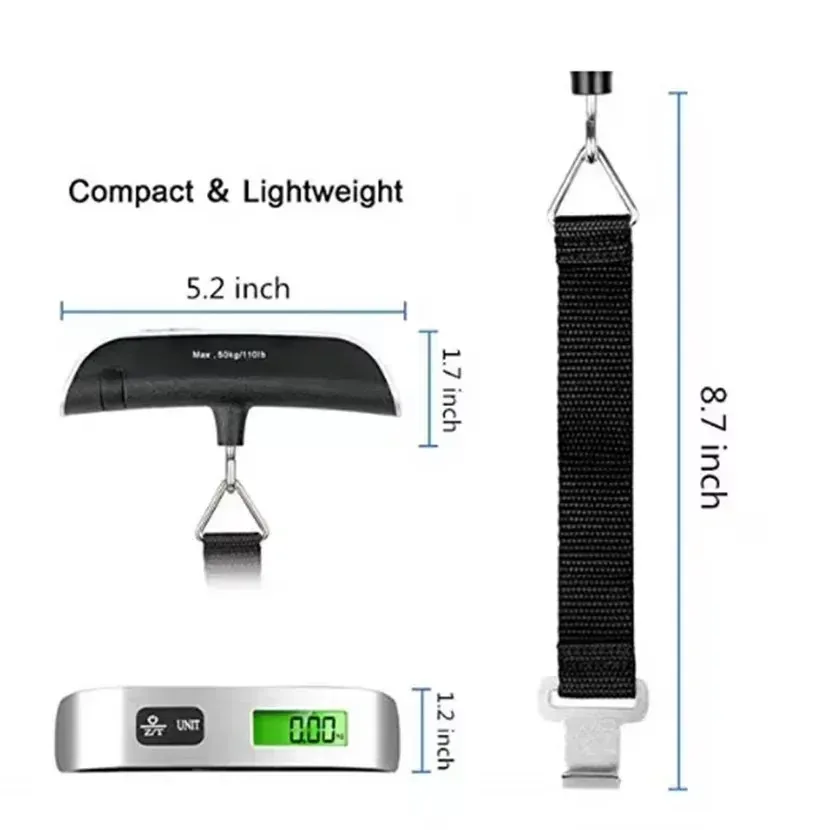
Compact 50 kg hanging luggage scale
The listing image shows a curved handheld body, digital display, metal attachment point, and webbing strap. The title claims a 50 kg (110 lb) capacity. Accuracy, calibration, battery life, and strap strength were not independently verified.
- Listing snapshot checked: August 2, 2026
- Marketplace signals displayed: 9,404 orders and a 98.0% positive rating
- Still verify: selected version, units, battery inclusion and type, capacity, display hold function, strap closure, shipping, taxes, returns, and current seller rating
- Do not assume: the airline and home scale will show exactly the same reading
Options, specifications, availability, order count, rating, price, shipping, and included parts can change after the research date.
A high order count does not establish measurement accuracy. Compare a new scale with a known reference before relying on it, and leave room below the airline limit.
Common mistakes before check-in
- Checking an old baggage allowance instead of the current itinerary.
- Ignoring case dimensions because the weight is acceptable.
- Using a bathroom scale on thick carpet.
- Taking one unstable reading as exact.
- Packing exactly to the limit with no return-trip margin.
- Lifting a heavy case with a rounded back or an outstretched arm.
- Moving restricted items between bags without checking safety rules.
Frequently asked questions
Can a phone weigh a suitcase?
Not by itself. A phone may connect to a compatible external scale, but ordinary phone sensors are not designed to measure suitcase weight accurately. Use a real scale.
Should suitcase wheels count toward the size?
Airline measurement rules commonly include external parts such as wheels and handles, but check the exact carrier’s wording. Measure the packed case at its largest outside dimensions.
What if the airport scale is higher?
The airline’s check-in measurement governs the bag it accepts. Calmly ask whether the reading can be repeated, then repack or pay the applicable charge according to the airline’s policy. A home reading is preparation, not a guarantee.
The useful choice is simple
Use the scale you already own when it gives repeatable readings and you can lift safely. Leave a margin below the airline’s current limit and measure the case as well. A handheld luggage scale earns space in the bag only when direct weighing will solve a repeated travel problem, especially on the return trip.