Need the Table Back? How to Store an Unfinished Jigsaw Puzzle
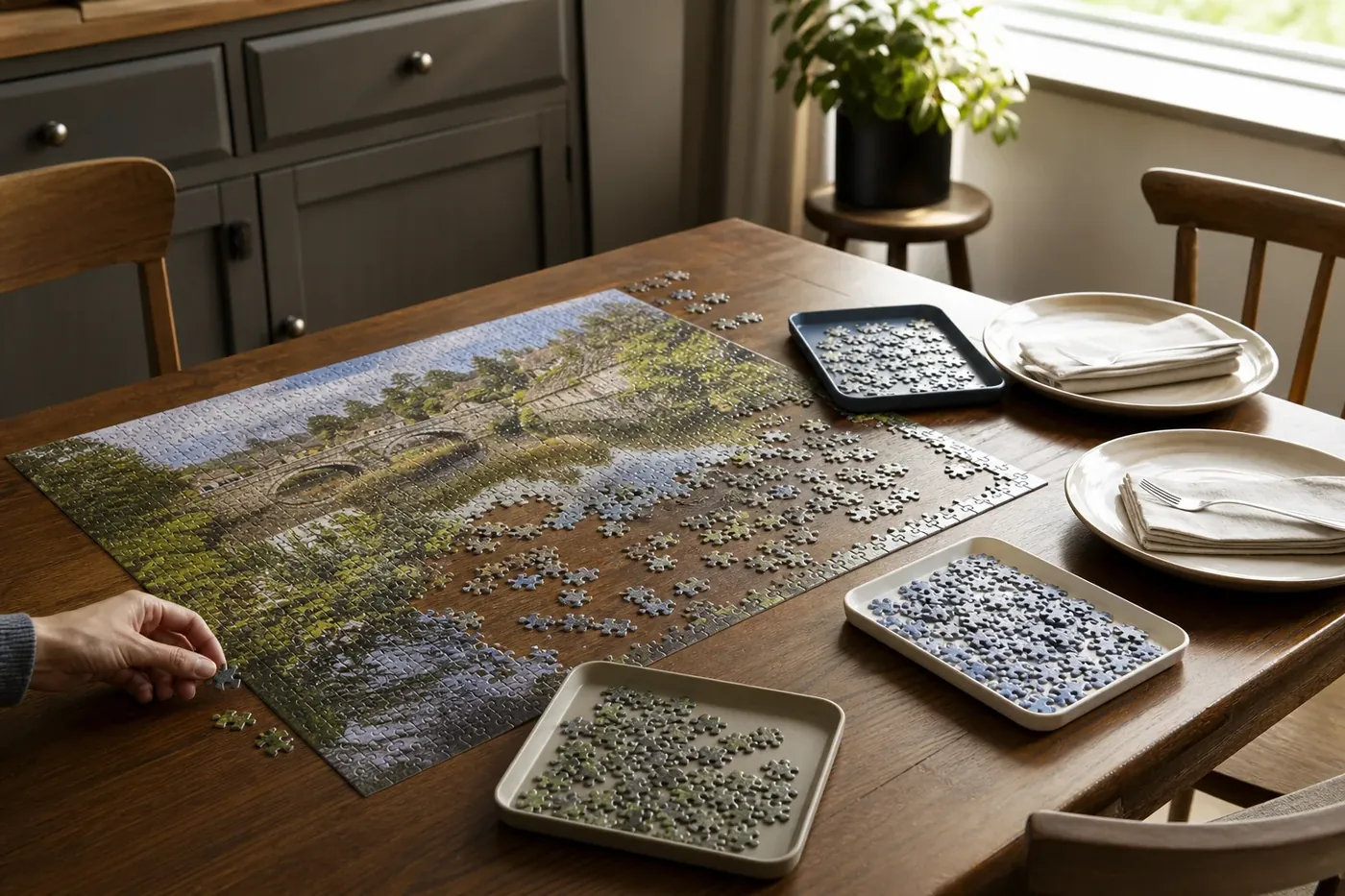
An unfinished jigsaw puzzle can quietly take over a dining table for days. The real problem is not that the puzzle needs a gadget. It is that you need the table back without losing the progress you already made.
Before buying a roll-up puzzle mat, decide how often the puzzle must move, where it could be stored, and how closely the piece positions need to be preserved. A flat board you already own may be the simpler answer. A mat becomes useful when compact storage matters more than keeping every loose piece perfectly still.
First, define what “put it away” means
Different storage problems need different solutions. Clearing the table for one meal is not the same as protecting a puzzle from a curious cat for a week. Ask what must happen after the table is cleared:
- Slide it into another room: a rigid board may be enough.
- Store it under a bed or sofa: check the available height and make sure the surface is clean, dry, and unlikely to be stepped on.
- Protect it from children or pets: moving it higher or closing it in a room is more dependable than simply covering it.
- Fit it into a closet: a roll-up mat may use less floor space than a large board.
- Move it frequently: a dedicated puzzle board with a cover may be easier to reopen than repeatedly rolling and unrolling felt.
This small distinction prevents a common mismatch. A roll-up mat is mainly a compact storage method. It is not a rigid carrying tray, a lockable cover, or a guarantee that every loose piece will stay in its exact position.
Try the flat-board method before buying anything
If the puzzle is already being built on a table, look for a flat board that is larger than the finished puzzle. A clean piece of foam board, sturdy poster board, smooth hardboard, or a large serving tray can work for a short test. The board needs to stay flat when lifted and should have no rough edge that can catch the pieces.
Build on the board from the beginning if possible. Keep loose pieces in shallow trays, box lids, or resealable bags rather than spreading them beyond the board. When the table is needed, move the loose pieces separately and slide the main board onto a safe, level surface.
A second lightweight board can serve as a dust cover, but do not assume that it locks the puzzle in place. If you need to carry the setup vertically, pass through a narrow doorway, or store it where someone may bump it, an improvised board can become awkward. That is the point at which a purpose-made storage option starts to earn its space.
Piece count is not a measurement
“Fits 1,000 pieces” sounds precise, but it is only a screening label. Finished dimensions vary by brand, piece shape, and puzzle format. Ravensburger says its typical 1,000-piece puzzle is about 70 by 50 cm, while its own size guide lists different dimensions for 500- and 1,500-piece formats. You can check the manufacturer’s 1,000-piece puzzle information and finished-size guide.
Other brands use their own cuts and finished sizes. For example, one official Buffalo Games 1,000-piece listing gives a finished size of 26.75 by 19.75 inches. That is close to, but not identical to, the Ravensburger example. The exact dimensions printed on your puzzle box are more useful than the piece count alone. See the Buffalo Games product specifications for that example.
Measure the mat’s usable puzzle area, not its total fabric size. Leave a border around the puzzle so edge pieces are not sitting at the roll line. Also check the tube length: it should span the full width of the puzzle orientation you plan to use.
When a roll-up puzzle mat genuinely helps
A roll-up mat is most convincing when the puzzle must disappear into a narrow storage space and a large rigid board has nowhere to go. You assemble directly on the felt, place the tube at one end, and roll the mat around it. Bands or straps keep the roll closed.
That basic method is not unique to marketplace products. Ravensburger’s official Roll Your Puzzle instructions describe a felt work surface, a tube, and securing bands for storage and transport. Its larger version uses the same general idea for bigger puzzles.
A mat is a reasonable candidate when all of these are true:
- you can start or continue the puzzle directly on the mat;
- the exact finished puzzle dimensions fit inside the usable area with a safe border;
- the tube is long and even enough for the chosen orientation;
- compact storage is more important than reopening the puzzle every day; and
- a small amount of piece realignment would not ruin the experience.
Felt can also reduce casual sliding while you work, which some people prefer and others find slow. If you like moving connected sections around the table, a smooth puzzle board may feel more natural.
When a mat may create a different problem
Rolling is not the same as pressing a completed layer between two rigid panels. Loose pieces can shift, connected sections can flex, and the mat itself can wrinkle if it was folded during shipping. The closer you are to finishing a large puzzle, the more frustrating that movement may feel.
Think twice about a roll-up mat when:
- the puzzle is already mostly assembled on a bare table and moving it onto felt would be risky;
- the puzzle has unusually thick, wooden, irregular, or raised pieces;
- you need every loose piece to remain sorted in its exact place;
- you will open and close the puzzle several times a day;
- the only storage spot could crush, bend, or dampen the roll; or
- you really need a covered work surface rather than compact storage.
In those cases, a flat puzzle board, lidded puzzle case, or a dedicated side table may solve the actual problem better. The right choice depends less on the product’s piece-count headline and more on how the puzzle moves through your home.
How to reduce disruption when rolling
No flexible storage method can promise zero movement, but a careful setup can reduce avoidable disruption:
- Flatten the mat first. Follow the product instructions for relaxing folds or creases before starting the puzzle.
- Build on the mat. Transferring a partly assembled puzzle from a table to soft felt can be harder than using the mat from the beginning.
- Remove loose sorting piles. Put unplaced pieces in trays or bags so they do not stack against connected sections inside the roll.
- Use the full tube. Keep it straight across the mat and roll slowly with even tension rather than pulling from one side.
- Secure both ends evenly. Follow the listing or manufacturer’s directions for bands and storage position.
- Unroll on a clear surface. Give yourself room to flatten the mat and make small corrections before continuing.
If preserving exact positions is non-negotiable, use a rigid solution instead. A flexible mat should be judged by whether it makes storage manageable, not by an unrealistic promise that nothing will move.
A current roll-up mat example, with limits
Affiliate disclosure: This section contains an affiliate link. If you buy through it, GadgetPickLab may earn a commission at no extra cost to you. This listing is included as a current example of the product type, not as a hands-on-tested endorsement.
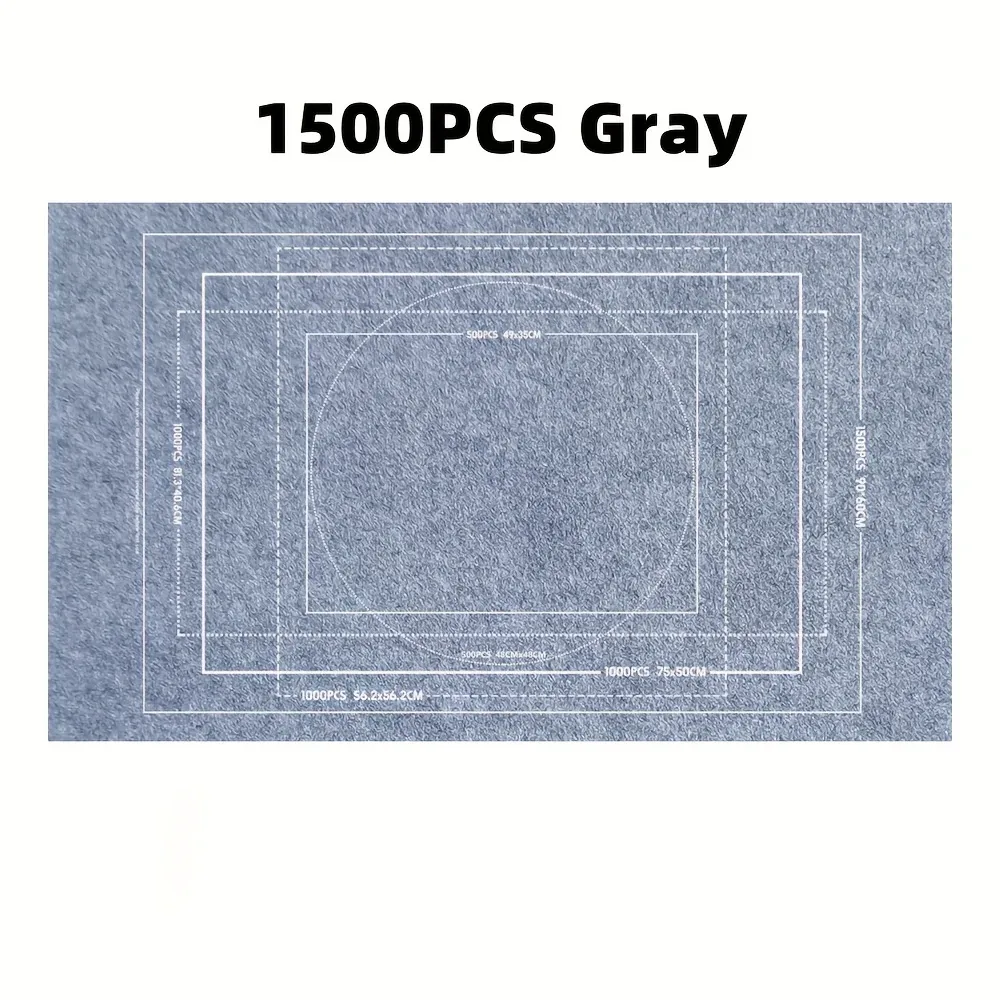
Gray roll-up mat listed for 500, 1,000, and 1,500-piece puzzles
The listing image marks several puzzle areas on the felt, which is more useful than a generic lifestyle photo. It still does not replace checking the finished dimensions on your puzzle box and the exact size of the selected mat variant.
- Listing snapshot checked: July 28, 2026
- Price displayed during research: US$8.33
- Marketplace signals displayed: 495 orders and a 98.0% positive evaluation
- Still verify: selected color and size, usable dimensions, included tube and straps, shipping cost, and return terms
Check the current AliExpress listing
Price, availability, order count, evaluation rate, product contents, and options can change after the research date.
The practical decision
Start with the least complicated solution that gives the table back. If a flat board can slide safely under a bed or onto a shelf, you may not need anything else. If you have no place for a puzzle-sized board and only need to reopen the project every few days, a correctly sized roll-up mat becomes a sensible compromise.
Measure the completed puzzle, measure the storage space, and decide how much movement you can tolerate. Those three checks tell you more than the product photo. The best puzzle accessory is the one that lets you keep enjoying the hobby without turning a shared table into permanent storage.
Common questions
Will a roll-up mat keep every piece exactly in place?
Do not count on exact placement. The tube supports the roll, but the mat is flexible and loose pieces may shift. If exact preservation matters, choose a rigid board or case with a fitted cover.
Can I use a 1,500-piece mat for a 1,000-piece puzzle?
Possibly, but compare dimensions rather than labels. The larger mat still needs to fit your table and storage area, and its tube must work with the orientation of your puzzle.
Does a mat protect a puzzle from pets?
It can help you move the puzzle to a safer location, but the material and securing bands are not a pet-proof container. Store the roll somewhere animals cannot scratch, crush, or pull it down.