4DRC V8 Replacement Battery: Fit and Charging Checks
This listing is for a replacement battery, not a drone. A spare can reduce waiting between short flights, but only when it matches the exact 4DRC V8 version, compartment, connector, polarity, and charging method. The words “3.7V 850mAh” by themselves are not enough to establish compatibility.
Quick decision
- Consider a spare if: the original battery is healthy, the aircraft and charger work normally, and you can match every physical and electrical detail.
- Do not buy yet if: the original battery has no readable label, the connector photos do not show wire order, or the seller cannot confirm your exact model version.
- Stop using the old pack if: it is swollen, punctured, leaking, unusually hot, damaged after a crash, or has torn wires or an exposed connector.
Use the battery already in your drone as the reference
Remove the original only as described in the aircraft manual. Photograph the label, connector from the front and back, wire colors and order, cable exit direction, and how the pack sits in the compartment. Measure the battery body and available space without squeezing the pack.
If the original battery is missing, do not rebuild the specification from a product title alone. Find the manual for the exact model number printed on the aircraft or contact the manufacturer or seller. Similar-looking V8, V8 Mini, and other 4D/4DRC names may not identify the same connector or pack.
Eight details that need to match
- Exact aircraft version. Match the full model marking on the drone and, if available, the original battery part number.
- Nominal voltage and cell count. The listing describes a 3.7V pack. Do not substitute a higher-voltage pack because the plug happens to fit.
- Connector housing. Compare the plug shape, latch, pin count, size, and keyed orientation from clear close-up photos.
- Polarity and wire order. Two connectors can look identical while the positive and negative wires are reversed. Ask the seller if the listing does not show this clearly.
- Body dimensions. Length, width, and thickness must fit without crushing the pack or forcing the battery door.
- Cable position and length. The wire must reach without crossing a propeller, pinching under a cover, or pulling on the connector.
- Capacity and weight. The listing names 850mAh, but a larger number is not an automatic upgrade. Added bulk or weight can affect fit and flight behavior.
- Charging method. Confirm that the charger or USB lead is intended for that exact pack chemistry, voltage, connector, and version. Do not improvise an adapter chain.
| What you find | Decision | Reason |
|---|---|---|
| Model, voltage, connector, polarity, dimensions, weight, and charger all match | The listing may be a reasonable comparison | The key compatibility checks have evidence |
| Same voltage and capacity, but no clear connector or polarity photo | Ask before ordering | A plug mismatch can make the pack unusable or unsafe |
| The pack only fits when squeezed or the door is forced | Do not use it | A lithium pack should not be crushed or pinched |
| The original battery is swollen, damaged, or abnormally hot | Stop charging and using it | The problem is battery condition, not a need for more capacity |
Current listing example: 4DRC V8 3.7V 850mAh battery
The linked AliExpress listing is described as a 4DRC V8 Drone Original Battery 3.7V 850mAh replacement pack. GadgetPickLab has not hands-on tested this exact item. Listing names, photos, options, included chargers, and specifications can change, so compare the selected variant—not only the main thumbnail—with the original battery.
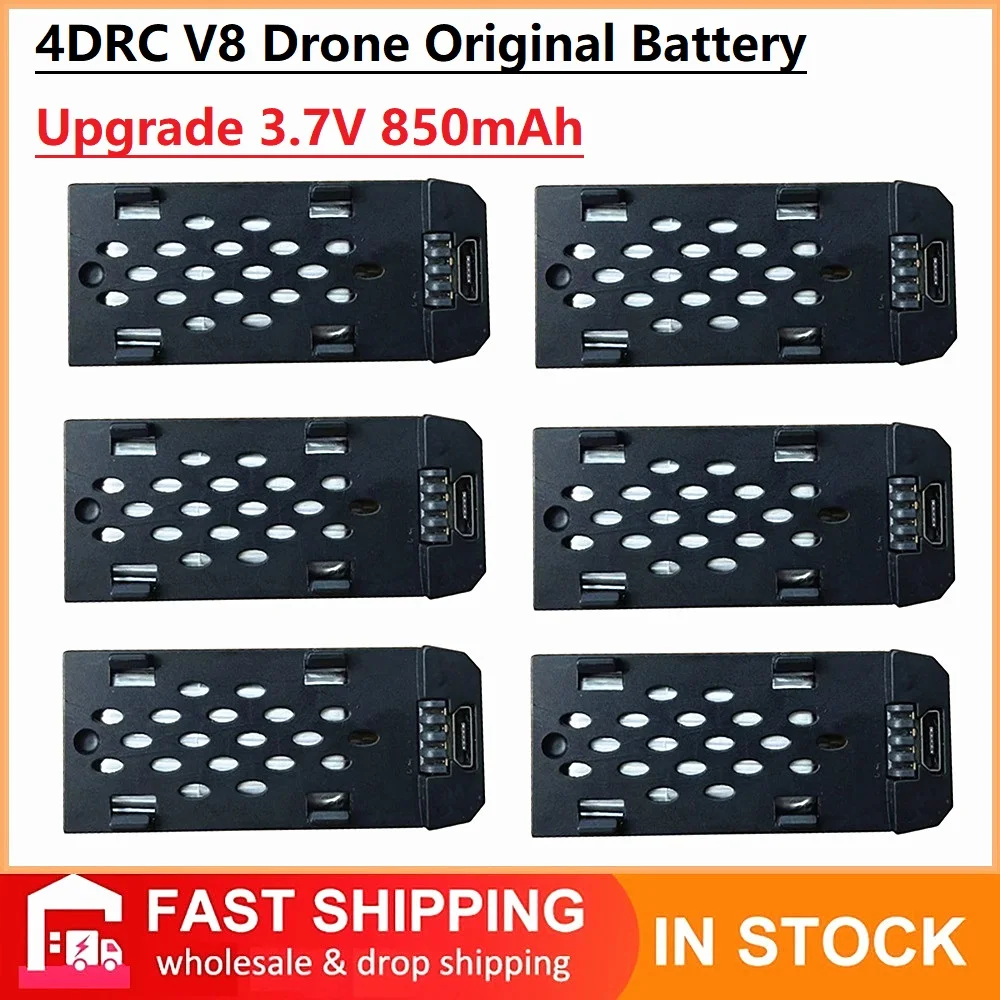
Check these details on the live listing
- Does the seller name your exact 4DRC V8 version?
- Do close-up photos show the connector and wire order clearly?
- Are battery dimensions and weight stated for the selected option?
- Is the 3.7V 850mAh marking visible on the pack you will receive?
- Is a charger included, and if so, which connector and input does it use?
- Do recent buyer photos match the current main listing images?
Charging and handling: keep the routine boring
The U.S. Consumer Product Safety Commission has warned that rechargeable lithium batteries used in remote-controlled helicopters and airplanes can overheat or ignite when charged improperly, and it tells users to follow the manufacturer’s charging instructions. The FAA also notes that damaged, overheated, overcharged, or improperly packed lithium batteries can enter thermal runaway.
- Use only the charging method specified for the exact battery and aircraft. A connector adapter does not make an incompatible charger suitable.
- Inspect the pack and wires before and after flight. Stop if you see swelling, puncture damage, torn insulation, leakage, smoke, unusual odor, or abnormal heat.
- Charge where you can stay present and respond, away from paper, bedding, upholstery, and other easily combustible materials.
- Do not crush the battery under a tight door or leave its cable where a propeller or hinge can cut it.
- Protect loose terminals from contact with keys, coins, tools, or other metal objects.
- Keep batteries out of a hot parked car and follow the manufacturer’s storage instructions between uses.
For background, see the CPSC alert for rechargeable batteries in RC aircraft and the FAA’s current lithium battery guidance.
Travel and disposal need separate checks
Rules vary by country and carrier. In the United States, FAA guidance says spare lithium batteries must be carried in carry-on baggage, protected from damage, and packed so their terminals cannot short-circuit; airlines may be stricter. Check the current rules for every carrier and destination before travel.
Do not place a damaged lithium battery in ordinary household trash or ship it casually. Follow the manufacturer’s instructions and ask a local hazardous-waste or battery-recycling program how to handle the specific damaged pack.
FAQ
Is every 3.7V 850mAh battery compatible with the 4DRC V8?
No. Voltage and capacity are only part of the match. Connector and polarity, dimensions, cable position, weight, charging method, and exact aircraft version matter too.
Can a higher-capacity battery give more flight time?
It may in a supported setup, but extra size or weight can prevent proper fit or change flight behavior. Use the manufacturer’s supported specification rather than choosing by the largest number.
Should a swollen or damaged battery be charged again?
No. Stop using it, keep it away from combustible materials, and follow the manufacturer or local hazardous-battery disposal guidance.
How should spare lithium batteries be packed for air travel?
Check current airline and destination rules. FAA guidance says spare lithium batteries must stay in carry-on baggage and their terminals must be protected from short circuit.
Affiliate disclosure
This article includes one affiliate-linked listing example. GadgetPickLab may earn a commission at no extra cost to you if you buy through the link. The exact battery has not been hands-on tested, and compatibility and safe charging must be confirmed from current product and manufacturer information.